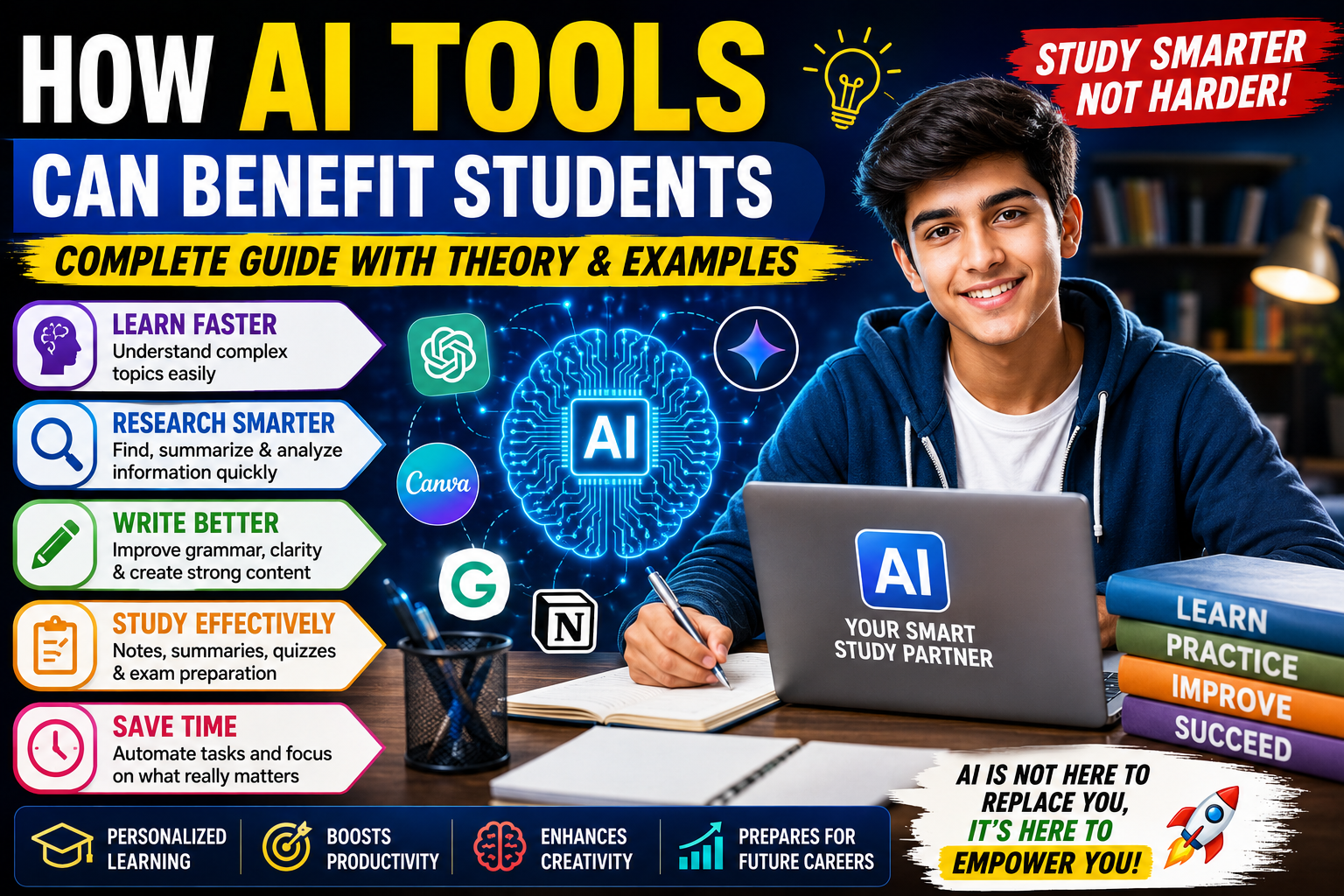
Artificial Intelligence (AI) is one of the most significant technological innovations of the 21st century. It is transforming industries, businesses, healthcare systems, and educational institutions around the world. In education, AI tools are changing how students learn, conduct research, solve problems, and develop skills for the future.
Today, students have access to powerful AI tools that can assist with studying, writing, research, language learning, exam preparation, and productivity. These tools are becoming increasingly popular because they provide personalized learning experiences and help students overcome many of the challenges associated with traditional education.
To understand how AI tools benefit students, it is important to first understand the theory behind Artificial Intelligence and its role in modern learning environments.
Understanding Artificial Intelligence
Artificial Intelligence refers to the ability of computer systems to perform tasks that typically require human intelligence. These tasks include learning, reasoning, problem-solving, decision-making, language understanding, and pattern recognition.
AI systems are developed using technologies such as:
- Machine Learning (ML)
- Natural Language Processing (NLP)
- Deep Learning
- Neural Networks
- Data Analytics
These technologies enable AI tools to understand user requests, analyze information, and generate useful responses.
Popular AI tools used by students include:
- ChatGPT
- Google Gemini
- Microsoft Copilot
- Grammarly
- Canva AI
- Notion AI
These tools are designed to assist users in completing tasks more efficiently and effectively.
The Theory of AI in Education
Educational theorists have long emphasized the importance of personalized learning. Traditional classrooms often follow a one-size-fits-all approach where all students receive the same instruction regardless of their learning speed and style.
AI supports the theory of personalized education by adapting learning experiences according to individual needs.
The concept is based on the idea that students learn more effectively when educational content is tailored to their abilities, interests, and pace of learning.
AI tools can provide:
- Individualized explanations
- Personalized feedback
- Adaptive learning materials
- Customized study recommendations
This approach helps students learn more efficiently and retain information better.
AI as a Learning Assistant
One of the most important theoretical applications of AI in education is its role as a learning assistant.
Traditional learning often requires students to wait for teacher assistance when they encounter difficulties. AI tools provide instant support whenever students need help.
For example, if a student struggles with mathematics, an AI assistant can explain formulas, provide examples, and guide the student through problem-solving steps.
This immediate access to assistance encourages independent learning and increases student confidence.
Improving Understanding of Complex Topics
Many students find subjects such as mathematics, physics, chemistry, computer science, and economics difficult to understand.
AI tools can simplify these complex subjects by:
- Breaking concepts into smaller parts
- Providing examples
- Using simple language
- Offering visual explanations
- Creating step-by-step solutions
According to Cognitive Learning Theory, students learn better when complex information is organized into manageable sections. AI supports this process by making difficult topics easier to understand.
Enhancing Research Skills
Research is a fundamental component of education. Students regularly conduct research for assignments, projects, presentations, and academic papers.
AI tools can significantly improve the research process by:
- Summarizing lengthy articles
- Identifying key information
- Explaining technical concepts
- Generating research outlines
- Suggesting relevant resources
The theory behind research-based learning emphasizes the importance of information gathering and analysis. AI tools help students spend less time searching for information and more time understanding and applying knowledge.
AI and Writing Development
Writing is one of the most important academic skills. Students are often required to write essays, reports, case studies, and research papers.
AI writing assistants help improve:
- Grammar
- Spelling
- Sentence structure
- Vocabulary
- Clarity
- Readability
From a theoretical perspective, writing improvement is linked to continuous feedback. Educational psychologists suggest that immediate feedback enhances learning outcomes.
AI tools provide instant corrections and suggestions, allowing students to identify mistakes and improve their writing skills more effectively.
Supporting Critical Thinking
Some people believe that AI may reduce students’ thinking abilities. However, when used correctly, AI can actually support critical thinking.
Students can use AI to:
- Compare ideas
- Analyze arguments
- Evaluate information
- Explore different perspectives
- Solve complex problems
Critical Thinking Theory suggests that students learn more effectively when they actively evaluate information rather than simply memorizing facts.
AI tools encourage deeper analysis by providing multiple viewpoints and explanations.
Personalized Learning and Adaptive Education
Every student learns differently. Some students learn visually, while others prefer reading or practical activities.
AI systems can adapt to individual learning preferences by offering:
- Customized lessons
- Interactive exercises
- Personalized quizzes
- Progress tracking
- Targeted recommendations
The theory of Adaptive Learning states that educational content should adjust according to student performance and needs. AI makes this possible by continuously analyzing learning behavior and providing appropriate support.
AI for Exam Preparation
Exam preparation can be stressful and time-consuming.
AI tools help students prepare more effectively through:
- Practice tests
- Mock exams
- Flashcards
- Revision notes
- Study schedules
Educational theories emphasize repetition and active recall as essential learning strategies.
AI-powered learning platforms can automatically generate quizzes and practice questions that reinforce knowledge and improve memory retention.
Language Learning Benefits
Learning a new language requires practice, repetition, and feedback.
AI tools can assist language learners by:
- Correcting grammar
- Improving pronunciation
- Translating text
- Teaching vocabulary
- Simulating conversations
Language Acquisition Theory suggests that consistent exposure and interaction improve language learning outcomes.
AI provides students with opportunities to practice languages anytime and anywhere.
Time Management and Productivity
Many students struggle with managing assignments, deadlines, and study schedules.
AI productivity tools help students:
- Create study plans
- Organize tasks
- Set reminders
- Monitor progress
- Improve focus
The theory of Self-Regulated Learning highlights the importance of planning, monitoring, and evaluating one’s learning activities.
AI supports these processes by helping students stay organized and motivated.
Encouraging Creativity and Innovation
Creativity is an important skill in modern education.
AI tools can assist students in:
- Generating project ideas
- Designing presentations
- Creating graphics
- Writing stories
- Developing innovative solutions
Constructivist Learning Theory suggests that students learn best when actively creating and exploring ideas.
AI encourages creativity by providing inspiration and helping students develop original concepts.
Preparing Students for Future Careers
The future workforce will increasingly depend on digital skills and AI technologies.
Students who learn how to use AI responsibly gain valuable competencies such as:
- Digital literacy
- Problem-solving
- Data analysis
- Communication skills
- Technological adaptability
Employers increasingly value these skills because AI is becoming integrated into many industries.
Learning to work alongside AI prepares students for future career opportunities.
Challenges of Using AI in Education
Although AI offers many advantages, there are also challenges.
Potential concerns include:
- Overreliance on AI
- Inaccurate information
- Reduced independent thinking
- Academic integrity issues
- Privacy concerns
Students should use AI as a learning tool rather than a replacement for effort and understanding.
Responsible use ensures that AI enhances education without compromising learning quality.
The Future of AI in Education
The future of education will likely involve greater integration of Artificial Intelligence.
Future AI systems may provide:
- Virtual tutors
- Real-time learning analytics
- Personalized educational pathways
- Advanced language translation
- Interactive learning environments
As technology continues to evolve, AI will play an increasingly important role in making education more accessible, effective, and personalized.
Conclusion
Artificial Intelligence is revolutionizing education by providing students with powerful tools for learning, research, writing, exam preparation, language development, and productivity. The theoretical foundations of AI in education are based on personalized learning, adaptive instruction, immediate feedback, and student-centered teaching approaches.
When used responsibly, AI tools can enhance understanding, improve academic performance, develop critical thinking skills, and prepare students for future careers. Rather than replacing traditional education, AI serves as a valuable assistant that helps students learn more efficiently and achieve their educational goals.
As AI technology continues to advance, students who embrace these tools wisely will be better equipped to succeed in an increasingly digital and technology-driven world.
Thank You
Thank you for taking the time to read this comprehensive article on how AI tools can benefit students. We hope this guide has provided valuable insights into both the theoretical and practical applications of Artificial Intelligence in education. Continue learning, stay curious, and use technology responsibly to unlock your full academic potential and prepare for a successful future.